How Do Multifamily Returns Actually Work?
If you invested $100,000 into an apartment community today, how would that investment actually make money?
If you're new to passive real estate investing, terms like cash-on-cash return, equity multiple, distributions, and hold period can make the process sound more complicated than it is.
At a high level, multifamily investors can potentially make money in two ways:
Cash flow while you own the property and profit when the property is eventually sold or refinanced.
Let's put some actual dollars behind that.
What Could a $100,000 Investment Look Like?
Consider a hypothetical multifamily investment targeting:
5-year hold
8% average annual cash-on-cash return
2.0x equity multiple
These are projections for educational purposes, not guaranteed returns.
An 8% cash-on-cash return means the investment is projecting average annual cash distributions equal to 8% of your original investment.
On $100,000, that's:
$8,000 per year
or approximately $667 per month on average.
Over five years, that would equal:
$40,000 in cash distributions.
A 2.0x equity multiple means that for every $1 invested, the investment ultimately returns $2 in total, including your original investment.
So if this hypothetical $100,000 investment achieved a 2.0x equity multiple, you would receive:
$40,000 in cash distributions during the five-year hold
$60,000 in additional profit at exit
$100,000 return of your original investment
Total cash returned: $200,000
Total profit: $100,000
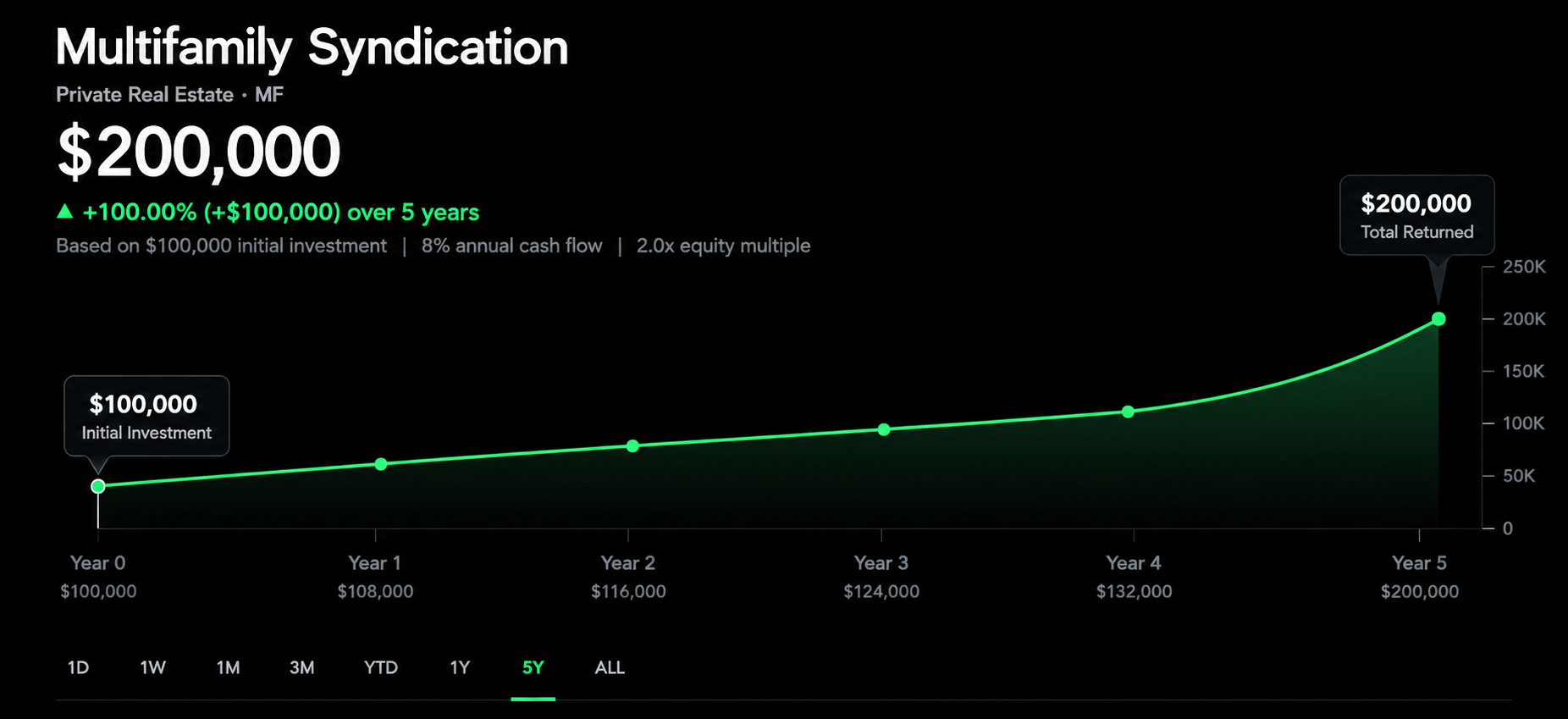
That's what “doubling your money” actually means in this example.
But there's a much more important question:
Where does that $100,000 of profit come from?
The Property Has to Produce the Return
An 8% return doesn't happen because someone put it in an investment presentation.
The apartment community has to perform.
Residents pay rent, creating income for the property. From that income, the property pays expenses such as maintenance, payroll, utilities, property taxes, insurance, and property management.
What's left after operating expenses is called Net Operating Income, or NOI.
The operating team, also called the General Partner or GP, works to improve the property's performance. That might include renovating units, improving occupancy, increasing revenue, controlling expenses, and operating the property more efficiently.
Increasing NOI can also increase the property's value.
That's how the two sides of the return connect:
The property can potentially generate cash flow while you own it, while the operating team works to create additional value that may be realized when the property is eventually sold.
The Projection Is Only the Beginning
None of those returns are guaranteed.
Occupancy can decline. Expenses can increase. Renovations can go over budget. Interest rates can change. Rent growth can slow. The property could ultimately sell for less than projected.
That's why I don't think investors should see 8% cash-on-cash and 2.0x equity multiple and stop there.
Ask:
Where is the projected cash flow coming from?
What assumptions are being made about rents and expenses?
How much debt is being used?
What happens if the business plan takes longer than expected?
What happens if the property sells for less than projected?
Who is responsible for executing the plan, and what experience do they have?
A projected return tells you where the investment is trying to go.
Understanding the business plan tells you how the team expects to get there.
Why This Matters
Building wealth isn't only about earning more money. Eventually, you have to decide what to do with the money you've already earned.

For many professionals, that money goes into a 401(k), stocks, a home, or savings.
Real estate gives you another option to explore: ownership in an income-producing physical asset.
You don't have to replace the investments you already have. Multifamily can potentially serve a different role alongside them.
And if you're thinking about shifting your financial legacy, I think that's where the conversation starts:
What do I own? How does it make money? What are the risks? And how can it help me build the future I want for myself and my family?
That's legacy shifting.
Next question: Where do you find $25,000, $50,000, or $100,000 to make your first passive real estate investment?
That's what I'll break down next.
Ready to Take the Next Step?
If multifamily investing is something you'd like to explore, we'd love to learn more about you and what you're working toward.