
What If Multifamily Investing Looked Like Your Brokerage Account?
If you invest in stocks, opening your brokerage account probably feels familiar.
You can quickly see what you invested, how much it has grown, whether it produces income, and what your investment is worth today.
Multifamily investing can feel much more complicated.
Cash-on-cash return. Equity multiple. IRR. Cap rates. Hold periods. GP teams.
But what if we displayed a multifamily investment the same way your brokerage account displays a stock?
It might make a lot more sense.
What if multifamily looked like your brokerage account??
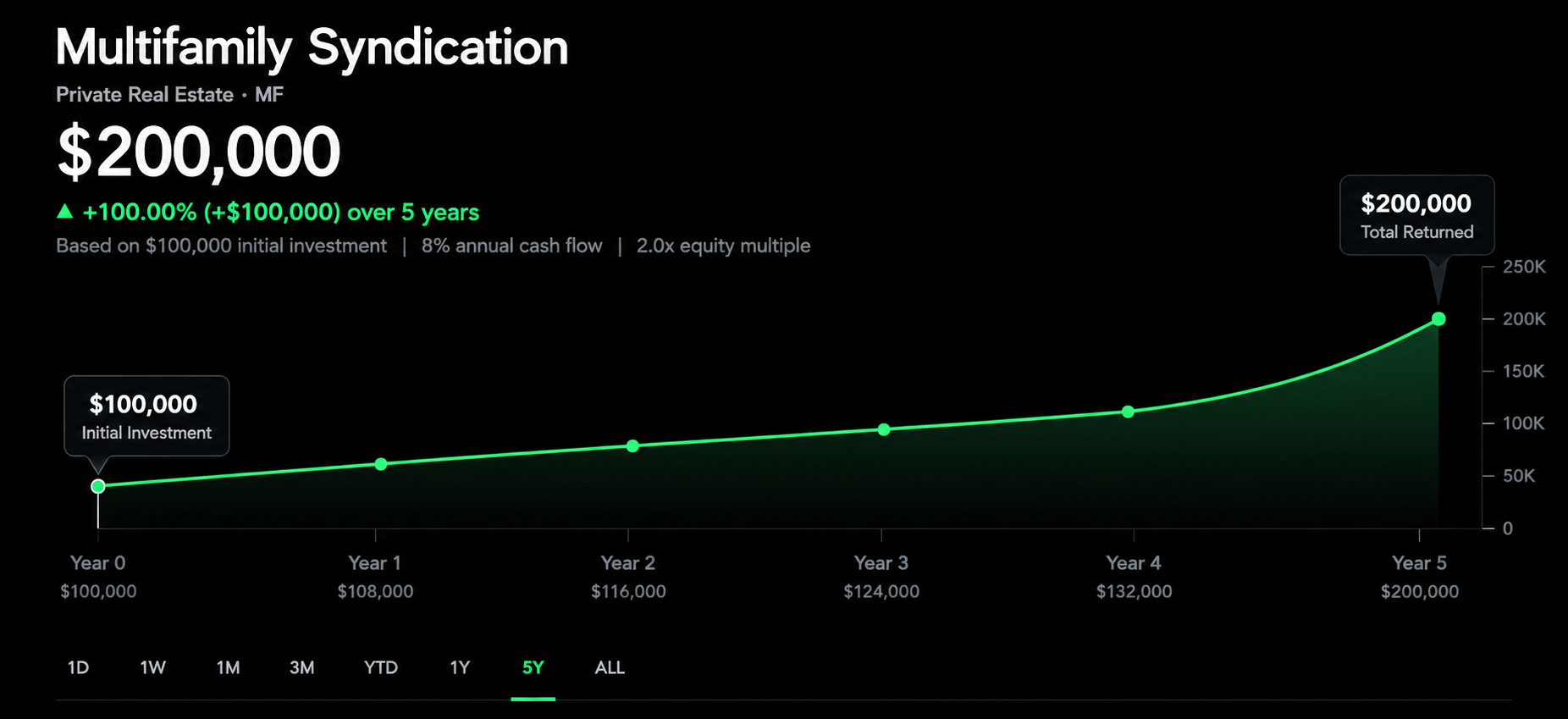
Let's use a simplified example.
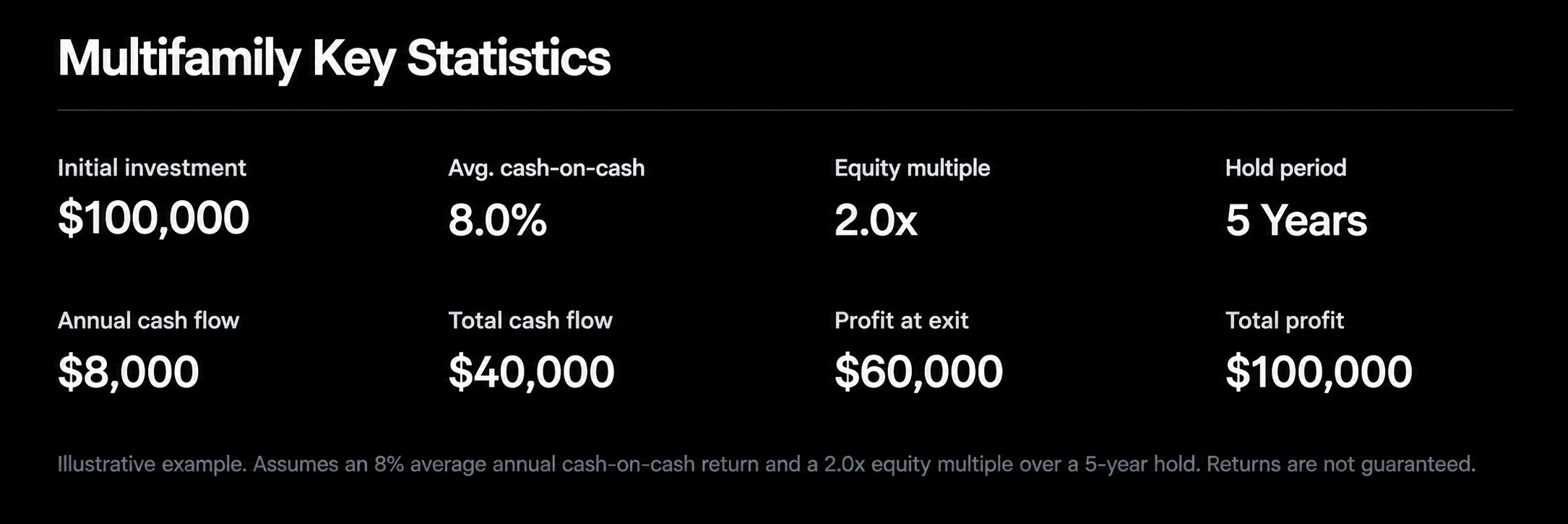
Imagine investing $100,000 into a multifamily syndication with an illustrative five-year hold, 8% average annual cash-on-cash return, and 2.0x equity multiple.
Over five years, that could look like:
$100,000 initial investment
$8,000 average annual cash flow
$40,000 total cash flow over five years
$60,000 additional profit at exit
$100,000 original capital returned
$200,000 total cash returned
In this example, every $1 invested ultimately returns $2, including the investor's original capital.
That's a 2.0x equity multiple.
The example is intentionally simple. Actual distributions can fluctuate, hold periods can change, and projected returns are never guaranteed.
The point is to make the mechanics easier to understand.
Because you may already understand more about multifamily investing than you think.
The language is different. The concepts aren't entirely foreign.
Stock investors are accustomed to looking at dividend yield to understand the income an investment produces.
Multifamily investors often look at cash-on-cash return.
The calculations are different, but both can help an investor evaluate income received while holding an investment.
Stock investors also think about appreciation.
Multifamily investors do too, but there's another component: creating value through operations.
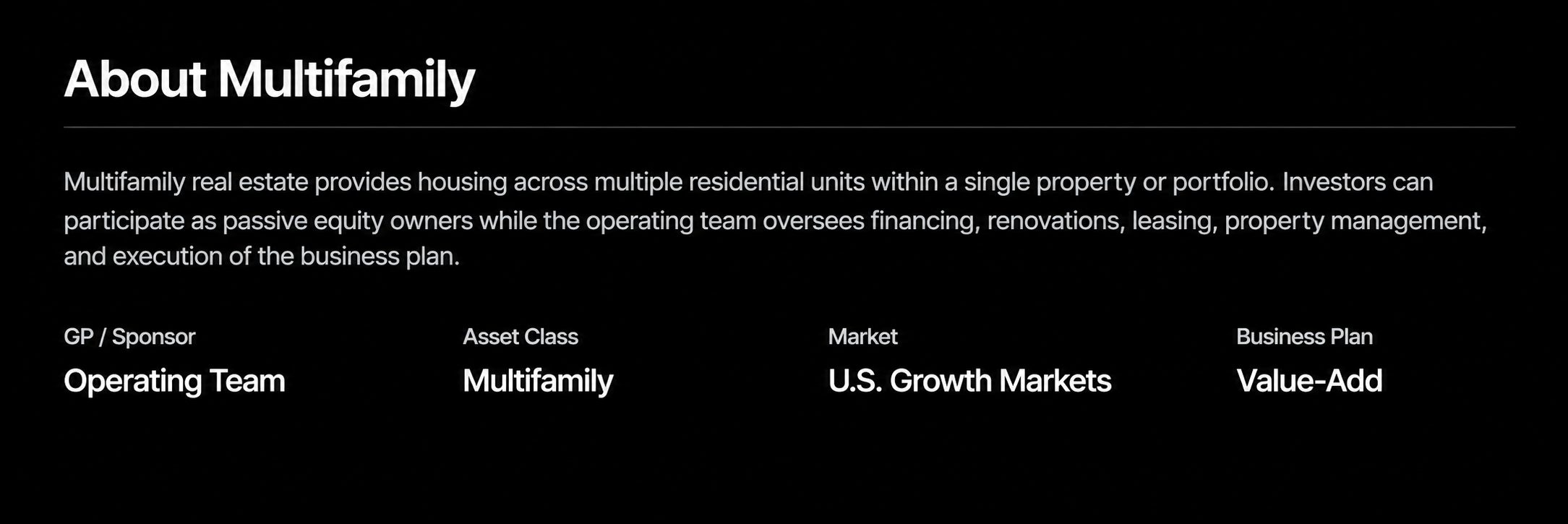
A multifamily operating team may renovate apartments, increase occupancy, improve collections, reduce unnecessary expenses, renegotiate vendor contracts, or make other improvements designed to increase the property's net operating income.
And instead of simply looking at a stock's total return, multifamily investors may use an equity multiple to understand how much money was ultimately returned relative to the amount invested.
Once I understood those translations, multifamily became much easier for me to evaluate.
But understanding the terminology wasn't enough.
I wanted to understand why I might consider owning multifamily alongside the investments already in my portfolio.
Three reasons multifamily interests me
1. Potential cash flow
Apartment communities generate revenue from rent.
After operating expenses and debt obligations are paid, available cash may be distributed to investors according to the investment's structure.
Stocks can produce dividends, too. What interests me about multifamily is the potential combination of ongoing distributions and a business plan designed to improve the underlying asset.
2. The opportunity to create value
When I buy shares of a public company, I have virtually no influence over what management does next.
With multifamily, the operating team has the ability to actively work to improve the property's performance.
Renovations, occupancy, expense management, leasing, and property operations can all potentially increase net operating income and ultimately property value.
That doesn't eliminate market risk, but it gives the investment another potential lever for creating value beyond appreciation alone.
3. A different ownership experience
Public markets continuously price investments.
Private multifamily isn't traded every second.
The underlying property's value can absolutely rise or fall, but investors aren't watching a ticker reprice their ownership throughout the day.
You're also investing in a physical asset that serves a fundamental need: housing.
For me, those characteristics make multifamily worth understanding as another potential component of a diversified portfolio.
But there is another side to the conversation.
Three risks I want to understand before investing
Every projected return comes with risk.
Education doesn't eliminate those risks. It helps me understand what I'm accepting before putting my capital to work.
1. Illiquidity
Stocks can generally be sold quickly during market hours.
A multifamily syndication may hold your capital for five years or longer, with limited or no ability to exit early.
That's why I don't want to invest money I expect to need during the projected hold period.
Before investing, I want to understand the expected timeline, distribution strategy and potential exit scenarios.
2. The business plan may not perform as expected
A multifamily investment is built on assumptions.
Rent growth. Occupancy. Renovation costs. Expenses. Financing. Interest rates. Exit value.
Those assumptions don't become reality because they're in a spreadsheet.
I want to understand how the projected return is supposed to be created.
What supports the projected rents?
What happens if renovations cost more?
What happens if income grows more slowly?
What happens if the property can't be sold for the originally projected value?
Understanding the downside is just as important to me as understanding the upside.
3. You're trusting an operating team with your money
Passive investing means someone else is responsible for execution.
That makes the GP or sponsor team extremely important.
I want to understand who found the opportunity, who underwrote it, who manages the property manager, who oversees the renovation budget, how decisions are made, and how the team communicates when things don't go according to plan.
The investment isn't only the property.
You're also investing in the people responsible for executing the plan.
So, does multifamily belong in my portfolio?
Maybe.
And I think that's a much healthier starting point than assuming every investor should own it.
I'm not learning about multifamily because I believe everyone should replace their stocks with apartment buildings.
Stocks provide liquidity, accessibility and ownership in businesses across virtually every part of the economy.
Multifamily offers something different: the potential for cash flow, ownership in a physical asset, and an operating strategy that can create value over time.
It also comes with different risks.
My responsibility as an investor is to understand both sides.
Learn how the investment makes money.
Understand how it can lose money.
Study the market.
Study the debt.
Study the assumptions.
And most importantly, study the people responsible for executing the plan.
You don't necessarily have to choose between stocks and real estate.
The better question may be whether multifamily deserves a place alongside the investments you already own.
That's a question worth educating yourself enough to answer.
Build ownership. Keep your time.
This article is for educational purposes only and is not an offer to sell or a solicitation to purchase securities. The example presented is hypothetical and does not represent guaranteed or actual investment results. All investments involve risk, including possible loss of principal.